
Weekly Roundup 03/03/26 - War.
What's it good for?

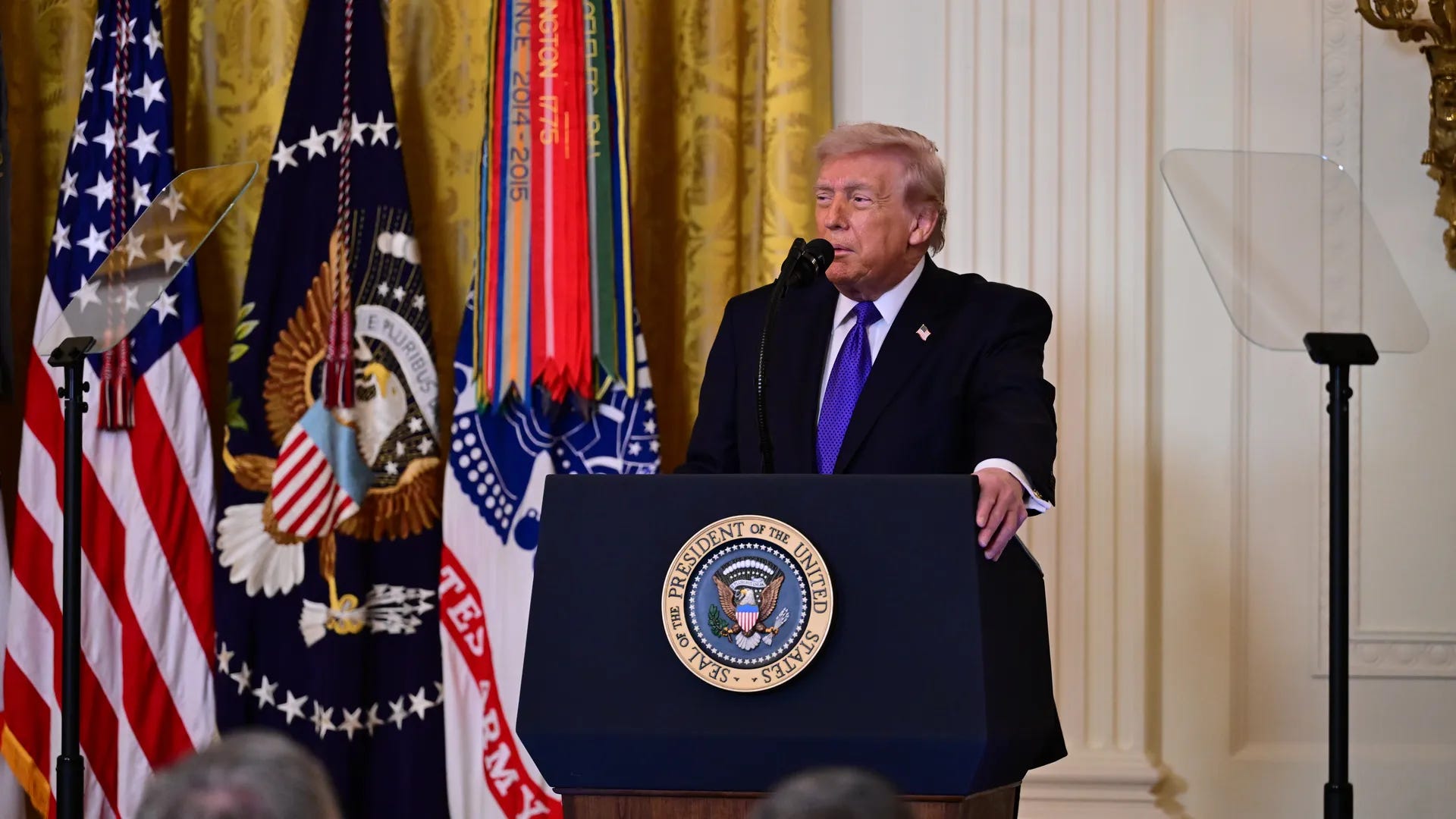
Above: Trump at a Medal of Honor ceremony. Kyle Mazza/Anadolu - Getty Images
The Middle Eastern Front
It is always easier to start a war than to end one.
President Trump, buoyed by his success earlier this year in Venezuela, may not have learnt this most vital lesson.
In the early hours of Saturday 28th February Israel and the United States began a series of coordinated military strikes against Iranian military, nuclear and infrastructure targets. Initial reports were confused but what we have since learned is that nearly the entire Iranian senior leadership, including Supreme Leader Ayatollah Ali Khamenei, has been killed.
In response, Iran has launched missile and drone attacks targeting US bases and the nations which host them across the Middle East.
All this has been widely reported, but the consequences of this action by the US may be far ranging.
1. What now?
So, you’ve killed the king. What’s the plan?
At the moment, at least from the US/Israeli side, there does not seem to be one beyond continuing their campaign against the Iranian regime. In Venezuela, we saw Delcy Rodríguez take over fairly quickly and while the regime remains no friend to the US, they are more compliant with US demands.
This does not appear to be happening in Iran. In an interview with ABC News Trump said: “It’s not going to be anybody that we were thinking of because they are all dead,”
He added: “Second or third place is dead.”
Was second or third perhaps their hope? We won’t know.
Speaking to Politico a source close to the situation said: “There’s no coordinated or breakaway group inside the regime that the Americans view as a new government they would welcome, or any real organized opposition,”
Trump does seem to rather fancy the Venezuelan method, despite the realities which stand in its way. Speaking to The New York Times he said: “What we did in Venezuela, I think, is the perfect, the perfect scenario,”
If that was the plan, it doesn’t seem to be working. Iran has formed a triumvirate to hold power until the clerics can appoint a new supreme leader and its military is fighting back and there does not seem to be an appetite in the regime for a negotiated end. They want to make it sting for the US and her allies in the region. Hezbollah has launched new attacks into Israel, the Houthis have begun attacking shipping again.
Iranian drones and missiles have been making it through and striking bases, energy centres and civilian targets across the region. If the US is unable to defend her allies from this wave of attacks then how long can these relationships hold?
All at this stage is very hard to parse. What is clear is that the region has been thrown into a conflict that few wanted and that has a significant risk of escalation.
So…
What now?
Who knows.
I must add that despite my scepticism of this action, no one is weeping for Khamenei or the rest of the vile men in the Iranian regime, least of all this channel. However, the method is what must be called into question. I fear that in killing Khamenei without a plan of what comes next then only more chaos will follow and, perhaps, a worse devil will rise in his place.
The Ukrainian Front
As we discussed last week, Ukraine has been making continued advances at a faster pace than the Russians achieved in 2025. As of early March 2026, Ukrainian forces have resumed limited counter offensive operations across several sectors of the front, achieving modest but politically significant gains. According to NV.ua, counter attacks launched in late January focused on the Oleksandrivka axis near the junction of Donetsk Oblast, Zaporizhzhia Oblast and Dnipropetrovsk Oblast, where Ukrainian Air Assault Forces reportedly liberated nine settlements and disrupted Russian supply lines.
President Volodymyr Zelenskyy stated that Ukraine has recaptured approximately 460 square kilometres of territory since the start of 2026, while Commander in Chief Oleksandr Syrskyi claimed Ukrainian forces regained more land in February than Russia captured during the same period.
Reuters reports Ukrainian advances in parts of Zaporizhzhia Oblast and Ukrainian forces have also stabilised positions around Kupiansk in Kharkiv Oblast, preventing renewed Russian breakthroughs.
However, Russia continues offensive pressure in eastern Donetsk Oblast and maintains numerical advantages in manpower and artillery. What it lacks since Musk turned off Starlink is a reliable communications system. We are now getting reports that Russian forces are using civilian radios for comms which are both easily jammed and monitored.
Zooming out, The Korea Times reports that South Korea is considering joining the PURL (Prioritized Ukraine Requirements List) programme to help finance the purchase of American weapons for Ukraine. This could be quite significant. South Korea has had involvement in Ukraine from the start and its despotic northern neighbour has sent troops to fight on Russia’s side, thereby gaining vital experience in modern warfare.
South Korea is also one of the few democracies outside the US which never drew down its arms industries and is able to produce significant amounts of weapons should they be needed.
Finally, the US and Israeli attack on Iran discussed above may indirectly aid Russia through a spike in oil prices. Russia is a petrostate and funds its war through oil and gas exports. At the moment these are at very unfavourable prices for the Russians, however if there is a shortage of oil thanks to the war in Iran, they may be able to negotiate higher prices for what they can send.